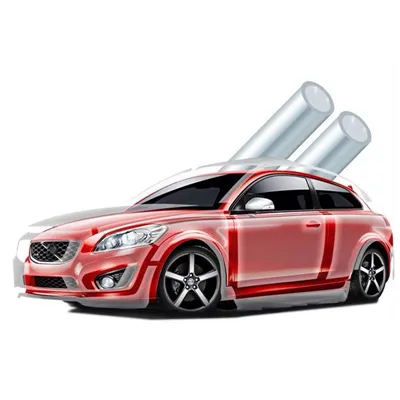
Based on different application areas, window films are currently broadly classified into three categories: architectural window films, automotive window films, and safety window films.
Architectural Window Films: Primarily designed for energy conservation and heat insulation, these films also offer UV protection and safety features. They can be further divided into heat-reflective films and low-emissivity films. Heat-reflective films, applied to the glass surface, allow visible and near-infrared light to pass through, but block far-infrared light. This allows sufficient light to enter the room while reflecting most of the solar heat back, preventing excessive increases in indoor temperature during hot summers and reducing the load on air conditioning, thus saving on air conditioning costs and energy. Low-emissivity films allow a certain amount of short-wave solar radiation to pass through, allowing solar heat to enter the room and be absorbed by indoor objects; simultaneously, they reflect and retain over 90% of the long-wave infrared radiation radiated by indoor objects. Low-emissivity films effectively utilize both solar radiation and the long-wave radiation from indoor objects. Therefore, they can provide insulation and energy savings in cold regions and heated buildings.
Automotive window film, applied to the inner surface of car windows, offers energy-saving insulation, UV protection, and security features. High requirements are placed on the visible light transmittance and reflectance of the film, especially for windshield film. According to the "Technical Conditions for Safe Operation of Motor Vehicles," "the visible light transmittance of the windshield must not be less than 70%, and mirrored reflective sunshade film is not allowed on any vehicle windows." Because it's used on car windshields, the visible light transmittance after application must be greater than 70% to meet the requirements of national standard GB7258-2004.
Safety window film has a highly adhesive layer between the film and the glass. The film itself has excellent tear resistance and penetration resistance. Even if broken, it maintains its original integrity, preventing secondary injuries from shattered glass in accidents. Its main function is safety and explosion protection, and it is generally used in important places or exhibition halls such as banks and other financial institutions, jewelry store windows, museums, and hotel lobbies. This type of film also has a certain degree of heat insulation and UV protection, and its transparency is relatively high. Window films can be broadly categorized into three types based on their manufacturing process: dyed films, primary color films, and vacuum-coated films. Dyed films can be further divided into ordinary films, surface-dyed films, and interlayer dyed films; vacuum-coated films can be divided into vacuum evaporation coating and magnetron sputtering coating; and according to the material used, they can be classified as metallic films and ceramic films.
Ordinary films, commonly known as "tea paper," are made by coating a polyethylene substrate with dye mixed in adhesive. This is the oldest production method, and due to its lack of heat insulation, UV protection, and short shelf life, it is rarely used now.
Surface-dyed films have dye coated on the surface of a PET substrate. They are very soft to the touch, lack sufficient toughness and explosion-proof properties, are not resistant to UV radiation, fade easily, and have a short shelf life.
Interlayer dyed films have dye coated between two layers of PET substrate. They are very soft to the touch and have some resistance to UV aging. Due to their low cost, this type of dyed film is still sold on the market.
Dyed film characteristics: Low visible light reflectance, poor heat control performance, prone to fading (usually turning purple), and prone to blistering after long-term use.
Natural color film: Refers to window film without added organic dyes. Currently, optical-grade PET film only comes in gray and colorless polyester films; other colors must be achieved through dyeing. Natural color film is characterized by a better feel, resistance to fading, and a longer shelf life.
Vacuum evaporation coating: By applying thermal evaporation (for pure metals with low melting temperatures), various metal, alloy, or oxide coatings can be deposited onto the film. Vacuum evaporation is typically used with pure aluminum and can produce films with different visible light transmittance and reflectance, giving the film optimal sunlight control performance.
Vacuum sputtering coating: Typically, in a large vacuum chamber, under low-pressure inert gas conditions and with the aid of electrical energy, various metal or metal composite targets are bombarded by charged ions to create multiple dense, low-reflection, high-heat-insulating metal film layers. These layers are then evenly and systematically coated onto the surface of a polyester film and, through a composite process, produced a variety of unique and stable colors with high selectivity for transmittance. This ensures the product has sufficient toughness, is explosion-proof, heat-insulating, UV-resistant (99%), and has a long shelf life.
Ceramic film: Window film containing ultra-thin ceramic coatings such as SiO2 and TiO2. It does not contain a metal layer and does not interfere with in-vehicle GPS navigation systems, radio communications, or mobile phone reception. It also does not oxidize or fade, is easier to maintain than metal films, and is durable. It has low reflectivity and moderate light transmittance. V-Kool's Amber Ceramic Film, 3M Crystalline Automotive Window Film, and Johnson's Basalt Series Automotive Film are examples of this type of product.
All of the above window film products must have one-way protection, that is, they can prevent damage from the outside to the inside, but they can prevent damage from the inside to the outside without any obstruction. In the event of accidents such as fire, earthquake, or car accident, people inside can easily break the glass to escape.